Last Updated on September 17, 2026 by Lydia — Salles & Co. Digital
Affiliate disclosure: This Zendrop Review contains affiliate links. If you subscribe to Zendrop through a link on this page, Salles & Co. Digital may earn a commission at no additional cost to you. Our editorial assessment is independent — we don’t soften critique to protect commissions, and we explicitly flag who should not subscribe. Read our full affiliate policy.
TL;DR — Quick Verdict
This Review cuts to the point: Zendrop is no longer just a supplier catalog — it’s an AI-routed fulfillment layer built for operators already running paid traffic and chasing margin compression. For dropshippers processing 50+ orders/month, the automation, US-based product pool, and AI sourcing tools justify the Pro tier ($49/mo). For beginners testing a first store, the free Starter plan is enough — paid tiers won’t fix a product-market problem. Verdict: strong fit for scaling operators, wrong fit for early-stage testers.
Who This Review Is Actually For
Picture this: you’re 14 months into your dropshipping store. You crossed $30K/month in revenue last quarter, but your margins are bleeding. Shipping times from your current supplier vary between 12 and 25 days. Customer service tickets are eating 6 hours of your week. Two winning products just got cloned by a competitor running ads with US fulfillment — and your AliExpress-routed orders can’t compete.
You don’t need another product research tool. You need a fulfillment layer that:
- Routes orders to faster suppliers automatically
- Gives you access to US-based inventory for hero products
- Cuts the manual sourcing back-and-forth
- Scales without adding hours to your operational load
If that’s the version of you reading this — Zendrop’s 2026 stack was built for your stage. If you’re still validating your first product, skip to the “Who This Is NOT For” section below. We’ll save you $49.
The Real Problem Isn’t Suppliers — It’s the System Behind Them
Most dropshipping issues are not caused by suppliers alone. They typically come from three overlapping factors: fragmented fulfillment processes, lack of control over logistics, and dependency on unstable sourcing.
This is where platforms like Zendrop enter — but with a distinction most operators miss.
If you’re not thinking in terms of systems yet, this is where most businesses get stuck. A full breakdown of how AI-driven systems work in practice — from acquisition to operations — is covered here:
The Role of AI in Building and Scaling an Online Business in 2026
Zendrop only makes sense once that bigger picture is in place. Modern operators need a system, not just a supplier — and that’s the gap Zendrop addresses: not as a growth engine, but as the fulfillment and supplier-control layer underneath the system.
Here’s how it works in practice.
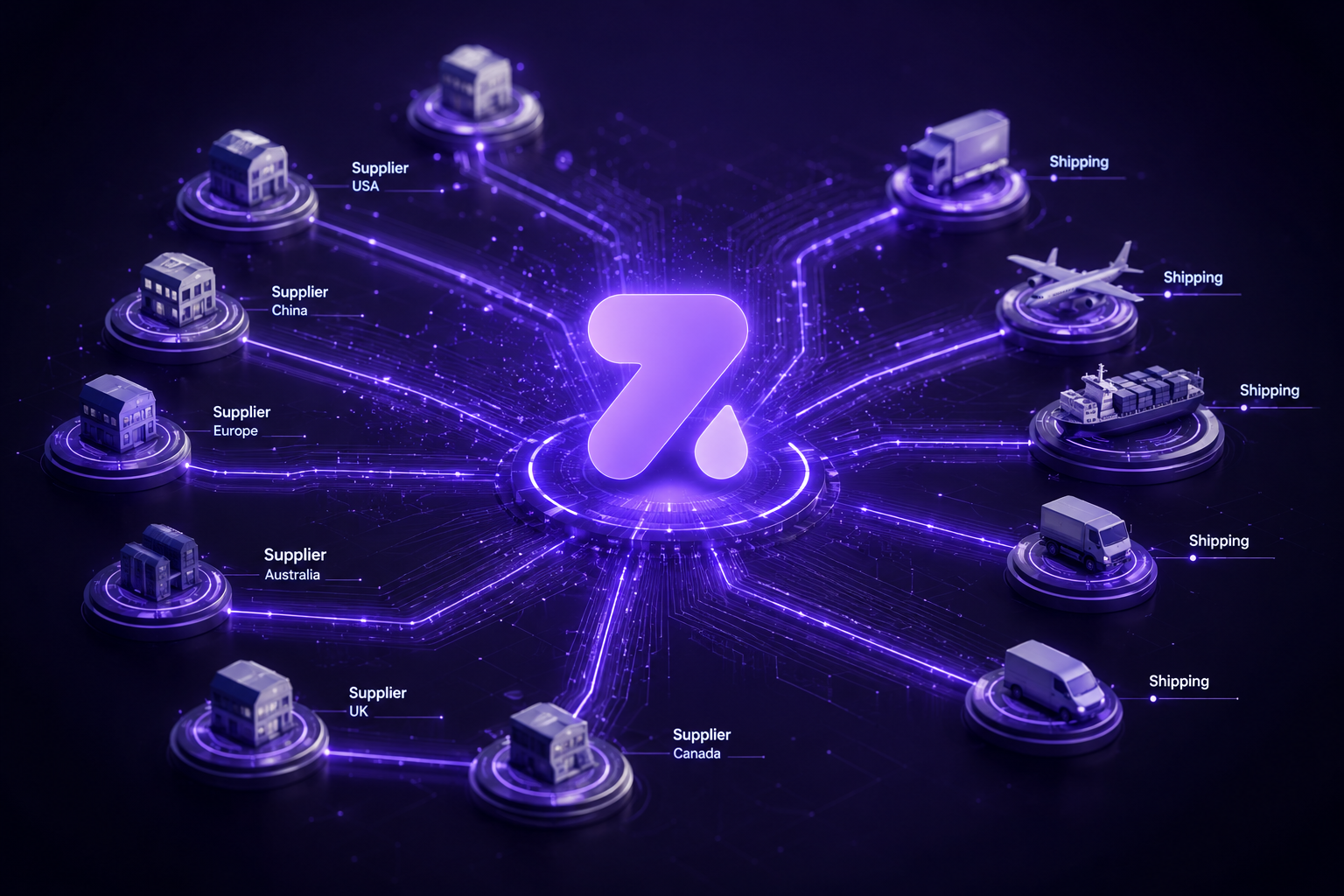
The AI Layer Inside Zendrop (What Most Reviews Miss)
Most Zendrop reviews still describe the platform as it existed in 2022 — a supplier catalog with a Shopify connector. That framing hasn’t kept up with the product. Three AI-driven functions define the 2026 version.
1. AI Product Sourcing
Paste a competitor’s product URL (AliExpress, Amazon, or a competitor Shopify store) and Zendrop’s sourcing engine returns matched supplier options with shipping time, cost, and reliability scores. What used to be a 2-day back-and-forth with an agent is now a 90-second decision.
For operators scaling past 5–10 SKUs, sourcing time was the bottleneck — this compresses it directly.
2. Automated Fulfillment Routing
Orders are automatically assigned to the supplier with the best composite score (cost + speed + reliability) at the moment the order drops — not at the moment you imported the product. If your primary supplier’s reliability dips, routing adjusts without manual intervention.
Why it matters: the difference between 8-day and 18-day shipping is the difference between a profitable ad account and a dying one.
This routing layer is the automation piece operators underestimate most — it’s not a feature you configure once, it’s a live decision system running behind every order. If you want to understand how this kind of operational automation fits into a broader AI stack (not just fulfillment), see: AI Automation for Online Business in 2026
3. AI Product Descriptions & Variants
The platform auto-generates conversion-oriented product descriptions, variant mappings, and image cleanup at import. Quality varies — you’ll still edit roughly 40% of outputs — but it removes the blank-page friction.
In a typical workflow, time-to-list drops from around 45 minutes per product to roughly 10 minutes.
Editorial note: the AI features sit on the Pro plan and above. The free Starter tier does not include them — which is why “try Zendrop free” reviews often miss what the paid product actually does.
Three Mistakes Operators Make With Zendrop
1. Subscribing before product validation
The most expensive mistake: upgrading to Pro ($49/mo) while still testing your first or second product. Zendrop solves operational drag, not market fit. If your product isn’t converting cold traffic profitably, paying for premium fulfillment just bleeds runway faster. Stay on the free Starter tier until you have 30+ recurring orders.
2. Treating Zendrop as a growth tool
Zendrop is infrastructure, not acquisition. It will not generate traffic, fix a weak offer, or rescue a saturated product. Operators who switch to Zendrop expecting revenue to jump are misreading what the platform does — it compresses operational cost, which compounds if you already have a working acquisition engine.
3. Underestimating the margin impact
US-based fulfillment and AI sourcing cost more per unit than the cheapest AliExpress options. The trade is faster shipping and lower CS load — which only pays off if your product LTV and ad economics justify it. Model your unit margin before migrating winning products. Some products simply don’t survive the cost shift.
Zendrop vs Other Fulfillment Options
| Option | Strength | Limitation |
|---|---|---|
| AliExpress | Variety, low entry cost | Slow shipping, inconsistent quality |
| CJ Dropshipping | Operational flexibility, custom sourcing | Steeper learning curve, manual workflow |
| Spocket | EU/US suppliers, faster shipping | Smaller catalog, higher per-product cost |
| Zendrop | AI sourcing, automated routing, US pool | Less flexibility for ultra-low-cost testing |
Zendrop trades catalog variety for delivery consistency — a trade-off that favors scaling operators over early-stage testers.
Zendrop Pricing in 2026 — What You’re Actually Paying
Zendrop runs two parallel billing models in 2026, and which one you land on depends on when and how you signed up. This is one of the least-documented friction points of the platform, and it matters before you subscribe.
Model A — Standard Plans (legacy users, direct Zendrop billing)
| Plan | Monthly | Annual | Includes |
|---|---|---|---|
| Starter | $0 | $0 | Catalog access only — no order processing, no imports |
| Pro | $49 | $399 (42% off) | Automated fulfillment, custom branding, US products, AI sourcing, unlimited orders |
| Plus | $79 | $549 | Everything in Pro + Zendrop Academy, weekly coaching calls, private listings, chargeback management, POD, TikTok Shop integration |
Model B — Usage-Based Billing (new users via Shopify)
New users signing up through the Shopify App Store are routed to a usage-based billing model:
| Linked Products (peak in cycle) | Monthly Cost |
|---|---|
| 0 products | Free |
| 1–20 products | $29/mo |
| 21–100 products | $49/mo |
| 101+ products | $79/mo (capped) |
Billing runs through Shopify directly. The cost adjusts based on your peak product count during the billing cycle — meaning if you imported 105 products mid-month and removed 90, you still pay the $79 tier for that cycle.
Why this matters
The migration to usage-based billing is a friction point that surfaces repeatedly in independent Trustpilot reviews about billing transparency. It’s not deceptive — the model is disclosed at signup — but it’s a real change in how costs are calculated, and it catches users coming from the legacy flat-rate framing off guard.
Practical implication: if you’re a high-SKU store testing 50+ products simultaneously, the usage-based model can be cheaper than the legacy Pro plan. If you’re running a tight 10-SKU operation, it’s comparable. If you import-and-delete frequently to test, model your costs carefully — peak counting can sting.
Who Zendrop Is For (And Who It Isn’t)
Zendrop is a strong fit if you are:
- Processing 50+ orders/month and feeling operational drag from manual sourcing
- Running paid traffic where shipping speed directly impacts ad economics
- Scaling past 5–10 SKUs and needing AI-assisted sourcing to keep velocity
- Looking for a US-fulfilled inventory layer to compete with faster competitors
- At $10K–$100K/month revenue stage where Plus tier coaching becomes a real asset
Zendrop is the wrong tool if you are:
- Validating your first product — no fulfillment platform fixes product-market fit
- Running a low-volume, high-margin niche with established supplier relationships
- Operating outside dropshipping-native categories (industrial B2B, regulated goods, custom manufacturing)
- Expecting fully autonomous store building — the AI accelerates, it doesn’t replace judgment
- Budget-constrained at under $500/month total tooling spend — Zendrop Pro + ad budget + Shopify stack adds up
Honest Pros and Cons
What Zendrop Does Well
- US-based product pool with realistic shipping windows. Not every product is US-fulfilled, but the inventory is genuinely larger than Spocket’s for dropshipping-native categories (home, beauty accessories, pet, fitness gear).
- AI sourcing collapses a 2-day workflow into 90 seconds for operators sourcing 5+ new products per week.
- Automated fulfillment routing reacts to supplier reliability shifts without manual reassignment — meaningful for stores running paid traffic where shipping variance kills LTV.
- Custom branding and private label options on Pro tier without an additional add-on fee.
- Plus tier’s coaching and chargeback management is a legitimate operational asset for stores at $50K+/month.
- TikTok Shop and POD integrations on Plus are functional, not bolt-ons.
What Zendrop Gets Wrong
1. Supplier quality is inconsistent across categories. Zendrop’s catalog quality varies meaningfully by category. Electronics and tech accessories have noticeably weaker reliability scores than home goods or pet products. Operators in tech-adjacent niches report needing to vet suppliers manually despite the platform’s reliability indicators.
2. Billing model migration creates transparency friction. The parallel existence of Standard Plans and Usage-Based Billing isn’t communicated clearly during onboarding for new Shopify-routed users. A non-trivial slice of Trustpilot complaints centers on users discovering they’re on a different billing structure than the one advertised on Zendrop’s public pricing page.
3. AI-generated content still requires human editing. The auto-generated descriptions and variant mappings remove blank-page friction, but quality is “draft-grade” rather than “publish-grade.” Plan for ~10 minutes per product of human editing. Reviews claiming “fully automated store building” with Zendrop are overstating what the AI delivers in 2026.

Final Verdict
Zendrop in 2026 is best understood not as a supplier catalog but as an AI-assisted fulfillment layer for dropshippers who have already crossed the product-validation threshold. For operators at the scaling stage — running paid traffic, managing 5+ SKUs, processing 50+ orders/month — the automation, US inventory access, and AI sourcing tools cut into the operational tax that kills most stores between $10K and $50K/month.
For early-stage testers, the free Starter plan is enough to explore the catalog. Don’t upgrade until you have a validated product and recurring order volume — the paid tiers solve scaling problems, not validation problems.
The billing model friction is real and worth flagging, but it’s a transparency issue, not a product issue. Once you understand which model you’re on, the cost structure is defensible.
For the scaling operator profile, Zendrop earns a recommendation. For the validation-stage tester, the recommendation is to wait.
If you’re still mapping which tools belong in your stack at which stage, the broader breakdown is here:
Best AI Tools for Online Business in 2026: What Actually Works.
FAQ
Does Zendrop’s AI sourcing work for every product category?
No. AI sourcing performs strongest in dropshipping-native categories like home, beauty, pet, and fitness. Electronics and tech accessories show weaker reliability scores, so manual supplier vetting is still recommended there.
Is Zendrop cheaper than AliExpress dropshipping?
Per-unit cost is typically higher on Zendrop due to US-based fulfillment and AI sourcing. The trade-off is faster shipping and lower customer service load, which only pays off if your product margins and ad economics support it.
Who should NOT subscribe to Zendrop Pro?
Anyone still validating their first product. Zendrop fixes operational drag, not product-market fit — upgrading before 30+ recurring orders usually just burns cash faster.
Why do some users report unexpected charges from Zendrop?
New users signing up via the Shopify App Store are placed on a usage-based billing model tied to peak product count per cycle, which differs from the legacy flat-rate Standard Plans. This distinction isn’t always clear at signu
How much manual editing does Zendrop’s AI content actually require?
Plan for roughly 10 minutes of editing per product. The AI-generated descriptions and variant mappings are draft-grade, not publish-ready, despite removing the blank-page friction.
About the Author
Lydia — Salles & Co. Digital
Lydia is a Strategic Affiliate at Next Level Learning Hub, reviewing tools and platforms for ecommerce operators navigating the scaling stage. Her reviews prioritize operational reality over launch hype — including who shouldn’t buy.
Some links may be affiliate links, meaning she may earn a commission at no additional cost to you.