
Last Updated on September 17, 2026 by Lydia — Salles & Co. Digital

Quick Answer
An AI for online business uses artificial intelligence to create content, convert visitors, automate operations, and measure results — but profit comes from the system, not the tools. The businesses that win treat AI as four connected gears (create → convert → automate → measure) that feed each other, rather than a pile of subscriptions hoping one of them pays off.
Why this matters now — and who this is for
AI adoption among small businesses has crossed the tipping point. Regular AI use among U.S. small and midsize businesses rose from 48% in July 2024 to 77% by January 2026, according to the Intuit QuickBooks 2026 AI Impact Report (a survey of more than 34,000 SMB owners across four countries). Adoption is no longer the question.
The question is profit. And here the picture is sharper than the hype suggests: McKinsey’s State of AI report (published November 5, 2025, surveying 1,993 respondents across 105 countries) found that while 88% of organizations regularly use AI in at least one function, only about 6% qualify as “high performers” capturing meaningful financial impact — and just 21% have actually redesigned a workflow around it.
That gap is the entire story. This guide is for the early-to-intermediate digital entrepreneur who already has access to AI tools and wants to know why access hasn’t turned into income — and what structure does. A note on the data: these figures cover SMBs and organizations broadly, not solopreneurs exclusively, so treat them as directional rather than precise to your case. The pattern, however, holds at every scale.
The thesis here is simple to state and harder to execute: a profitable AI online business is not a toolbox. It is a system of four gears that turn together.
What is an AI online business (and what it isn’t)?
An AI online business is a venture that uses artificial intelligence as operating leverage across its core functions — producing content, acquiring and converting customers, running back-office operations, and analyzing performance — to sell products, services, or information online.
What it is not is a business that “uses ChatGPT sometimes.” Using a model to draft an email is a task. A business is a repeatable system that turns inputs into revenue. The distinction matters because most people adopting AI in 2026 are improving isolated tasks while leaving the system around those tasks untouched — which is precisely why adoption has outrun profit.
In practice, this means the unit of value is not the prompt. It is the workflow. McKinsey’s data makes the point bluntly: workflow redesign was the single factor most correlated with AI-driven business impact, yet only one in five organizations had done it. The underlying mechanism is that AI compounds when it sits inside a designed process and evaporates when it floats around as ad-hoc help.
Why most AI online businesses stall before profit
The most common failure mode is not technical. It is structural. People adopt AI as a collection of point solutions — a writing tool here, a chatbot there, an automation app somewhere else — and end up with what one 2026 SMB benchmark called “orphaned tabs”: tools that consume attention and subscription fees without connecting to revenue.
The data frames the trap clearly. On one hand, businesses that do integrate AI well see real upside: 43% of AI-using U.S. small businesses reported revenue increases attributable to AI versus just 2% reporting declines — a 20-to-1 ratio that held steady across every quarter since April 2025 (QuickBooks 2026 AI Impact Report). On the other hand, the McKinsey high-performer figure of roughly 6% shows how few translate usage into durable financial impact.
What separates the two groups is not the number of tools. It is whether the tools form a loop. A common misconception is that the next subscription is the missing piece. The trade-off here is real: every tool you add increases capability and management burden. Past a point, more tools subtract from focus faster than they add to output. The businesses pulling ahead are the ones that built a closed system first and added tools to it deliberately — not the other way around.
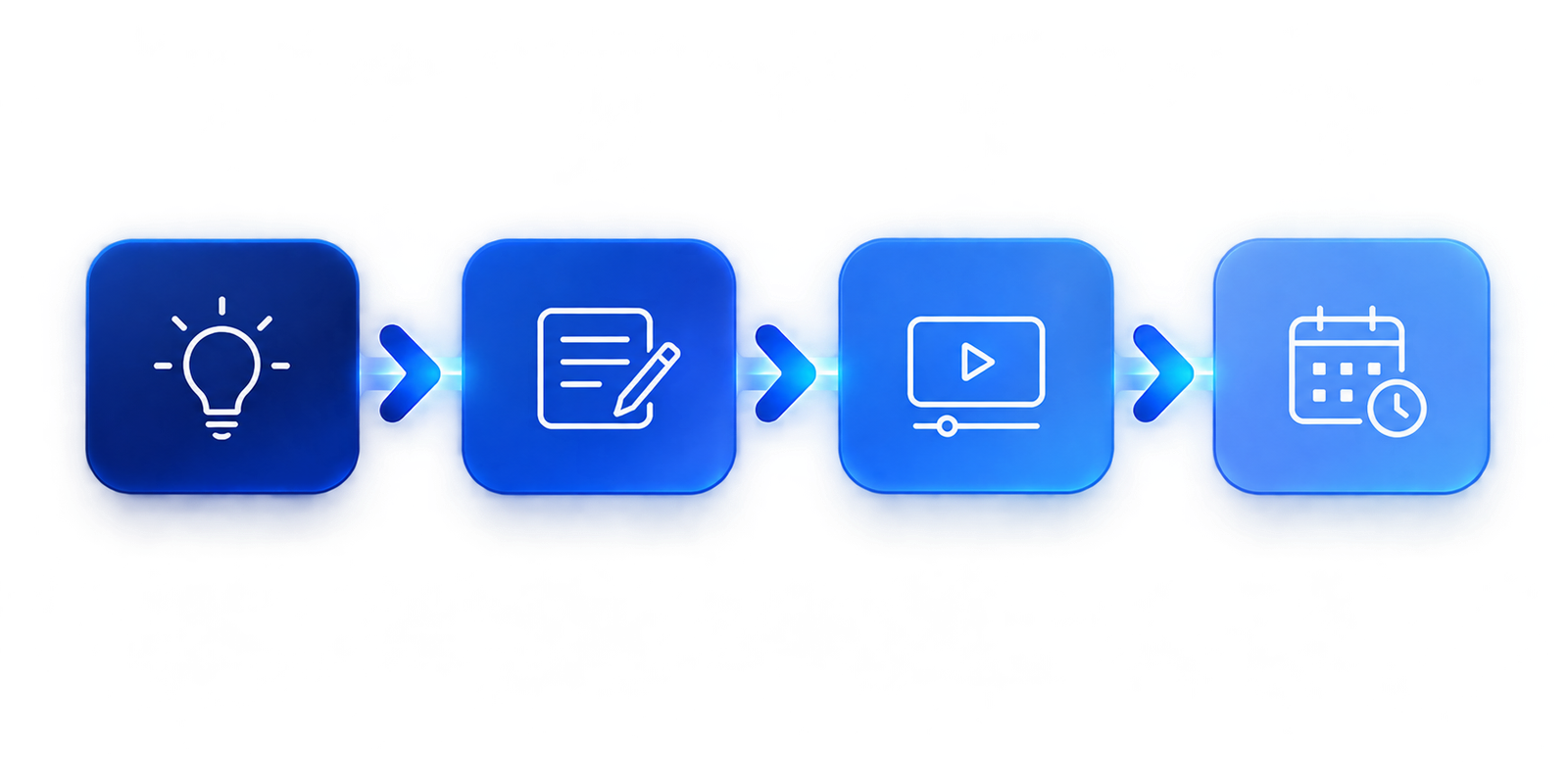
The 4-gear system: create → convert → automate → measure

Think of a profitable AI online business as four gears that turn together. If one gear seizes, the whole machine slows — and adding a fifth gear elsewhere doesn’t help.
- Create — AI helps you produce content at a volume and consistency that was previously impossible for a small team. But volume without direction is noise.
- Convert — Content has to move people toward a decision. AI supports the funnel: positioning, sequencing, and personalization that turns attention into leads and customers.
- Automate — Once a path converts, AI removes the manual repetition: follow-ups, onboarding, support, routine operations. This is where time gets bought back.
- Measure — Data tells you which gear to tighten next. Without measurement, you’re optimizing in the dark, and the loop never closes.
The reason this is a system and not a checklist is the feedback arrow. Measurement (gear 4) tells creation (gear 1) what to make more of. Conversion data tells you what to automate. The gears feed each other. That loop — not any single tool — is the asset.
A word of sequence: you turn these gears in order. Creating before you know what converts wastes effort; automating before you’ve validated a path just makes a broken process run faster. Which brings us to the most expensive mistake in the field — automating too early — covered below.
Gears 1 & 2: Creating and converting with AI
Gear 1 — Create. The job here is a repeatable production process, not a flood of posts. AI’s leverage shows up when content creation becomes a defined pipeline: ideation, drafting, editing, and repurposing, each with a clear human checkpoint. The output you want is consistency — the thing small teams historically couldn’t sustain. If you want the operational detail of building this pipeline, the deeper mechanics live in our breakdown of the AI content workflow for online business.
Gear 2 — Convert. Content that doesn’t move people toward a decision is a hobby. Conversion is where AI helps with structure: mapping the path from first touch to offer, sequencing email and landing-page logic, and personalizing the message to the visitor’s stage. The principle that matters: you convert on clarity, not cleverness. AI can generate a hundred variations, but the funnel architecture — what you ask for, when, and why — is a strategic decision. The full system for this sits in our guide to building an AI sales funnel.
These first two gears are where most beginners start, and that’s correct. What often gets missed is that they’re only half the machine. Producing and converting without the next two gears means you’ll hit a ceiling the moment your time runs out.
Gears 3 & 4: Automating operations and measuring with AI
Gear 3 — Automate. Automation is how you buy back time — but only after a process has proven it works. The mechanism is straightforward: take a validated, repetitive workflow (lead capture, follow-up sequences, onboarding, first-line support) and let AI run it so you don’t have to. The QuickBooks data hints at the payoff: businesses integrating AI well reported not just higher revenue but shorter workdays. The full operational is in our deep dive on AI automation for your online business.

Gear 4 — Measure. This is the gear most beginners ignore, and it’s the one that closes the loop. Measurement tells you which content actually converted, which funnel step leaked, and which automation saved real money versus which just looked busy. Without it, you can’t tighten the right gear — you’re guessing. AI now makes analytics accessible to non-analysts: surfacing patterns, flagging anomalies, and translating data into next actions. The mechanics of setting this up are covered in our guide to AI analytics for online business.
Here’s the distinction that matters: measurement is what makes the other three gears improve instead of just run. A business that creates, converts, and automates without measuring is a machine running open-loop — it works until it doesn’t, and you won’t know why.
Minimum stack vs. scalable stack: when to add a tool
One of the most practical questions is also one of the most mishandled: how many tools do you actually need? The SBE Council’s March 2026 Small Business Technology Use Survey found the median AI-using small business runs about five tools — a useful reference point, not a target to beat.
The principle is to start with a minimum stack: the smallest set of tools that lets all four gears turn at all. For most early-stage online businesses, that’s one capable general AI model, one tool per active gear, and your existing platform (site, email, payments). That’s it. The goal at this stage is to close the loop cheaply, not to own the best tool in every category.
You move to a scalable stack only when a specific gear becomes a measurable bottleneck — when gear 4’s data shows that a particular step is capping your growth and a specialized tool would clear it. The trade-off is always the same: capability gained versus management burden and cost added. A tool earns its place by removing a bottleneck the data has already identified, not by being impressive in a demo.
If you’re at the point of choosing specific tools, our comparison of the best AI tools for online business breaks down options by use case and stage.
What works vs. what doesn’t
Honesty matters more here than enthusiasm. Based on how these businesses actually perform, here’s the divide.
What works:
- Closing the loop before scaling. A small, connected four-gear system beats a large pile of disconnected tools. This is the consistent thread in the high-performer data.
- Redesigning a workflow, not just a task. McKinsey’s finding that workflow redesign is the top correlate of AI impact is the most actionable statistic in the field.
- Validating before automating. Automation multiplies whatever it’s pointed at — including a broken process.
- Measuring early. Even rough measurement beats none; it’s what tells you which gear to tighten.
What doesn’t (the myths):
- “More tools = more results.” No. Past your minimum stack, additional tools tend to subtract focus faster than they add output. The 20-to-1 revenue ratio in the QuickBooks data came from integration, not accumulation.
- “AI replaces strategy.” It doesn’t. AI executes decisions; it doesn’t make the strategic ones — what to sell, to whom, and through what path. A common misconception is that a good enough model removes the need to think. It removes the need to type.
- “Automate first, validate later.” This is the most expensive error in the field. Automating an unvalidated process means paying to run a mistake at scale. Validate the path with manual effort first; automate only what already works.
The pattern across all three myths is the same: they all assume the tool is the business. It isn’t. The system is.

Where to go next
- Building your content engine? Start with the AI content workflow (Gear 1).
- Turning attention into customers? See the AI sales funnel guide (Gear 2).
- Ready to buy back time? Read AI automation for your online business (Gear 3).
- Want to close the loop? Explore AI analytics for online business (Gear 4).
- Choosing tools? Compare the best AI tools for online business.
Key takeaways
- An AI online business profits from a system, not a stack of tools.
- AI adoption is now near-universal (77% of U.S. SMBs, QuickBooks 2026), but only ~6% of organizations capture real financial impact (McKinsey, Nov 2025) — the gap is execution.
- The system has four gears: create → convert → automate → measure, turning in a feedback loop.
- The order matters: don’t automate a process you haven’t validated, and don’t optimize without measuring.
- Workflow redesign — not tool count — is the top driver of AI impact.
- Start with a minimum stack; add tools only when data shows a specific bottleneck.
- The three persistent myths (more tools, AI replaces strategy, automate first) all share one false assumption: that the tool is the business.
Frequently asked questions
What is an AI online business?
It’s an online venture that uses AI as operating leverage across its core functions — creating content, converting customers, automating operations, and measuring results — to sell products, services, or information. The defining feature is a connected system, not occasional AI use.
Do I need a lot of AI tools to start?
No. Start with a minimum stack: one capable general AI model, one tool per active gear, and your existing platform. The median AI-using small business runs about five tools (SBE Council, March 2026), but more tools often subtract focus faster than they add output.
Why isn’t my AI usage making money?
Most likely because you’re improving isolated tasks rather than redesigning workflows. McKinsey’s 2025 data found workflow redesign is the single factor most correlated with AI-driven impact, yet only 21% of organizations had done it.
Should I automate my business with AI right away?
No. Automation multiplies whatever it’s pointed at, including a broken process. Validate a path manually first, then automate only what already works. Automating before validating is the most expensive common mistake.
Can AI replace strategy?
No. AI executes decisions efficiently but doesn’t make the strategic ones — what to sell, to whom, and through what path. It removes the need to do repetitive work, not the need to think.
What’s the difference between a minimum stack and a scalable stack?
A minimum stack is the smallest set of tools that lets all four gears turn. You move to a scalable stack only when measurement shows a specific gear is a bottleneck that a specialized tool would clear — capability gained versus cost and management burden added.
About the author
Lydia — Salles & Co. Digital
Lydia writes about building online businesses with AI as a system rather than a collection of tools, focusing on the structure that turns adoption into measurable results. Her work centers on practical frameworks for early-stage digital entrepreneurs navigating the gap between using AI and profiting from it.
Learn more about Salles & Co. Digital
Official sources: Intuit QuickBooks 2026 AI Impact Report (survey of 34,000+ SMB owners, U.S./Canada/U.K./Australia); McKinsey State of AI report, published November 5, 2025 (1,993 respondents, 105 countries); SBE Council Small Business Technology Use Survey, March 2026.