Last Updated on September 17, 2026 by Lydia — Salles & Co. Digital
Disclosure: This post (Mida AI A/B testing review) contains affiliate links. If you sign up through one of them, we may earn a commission at no extra cost to you. This doesn’t influence what we cover below — the good and the limitations both get equal airtime.
TL;DR
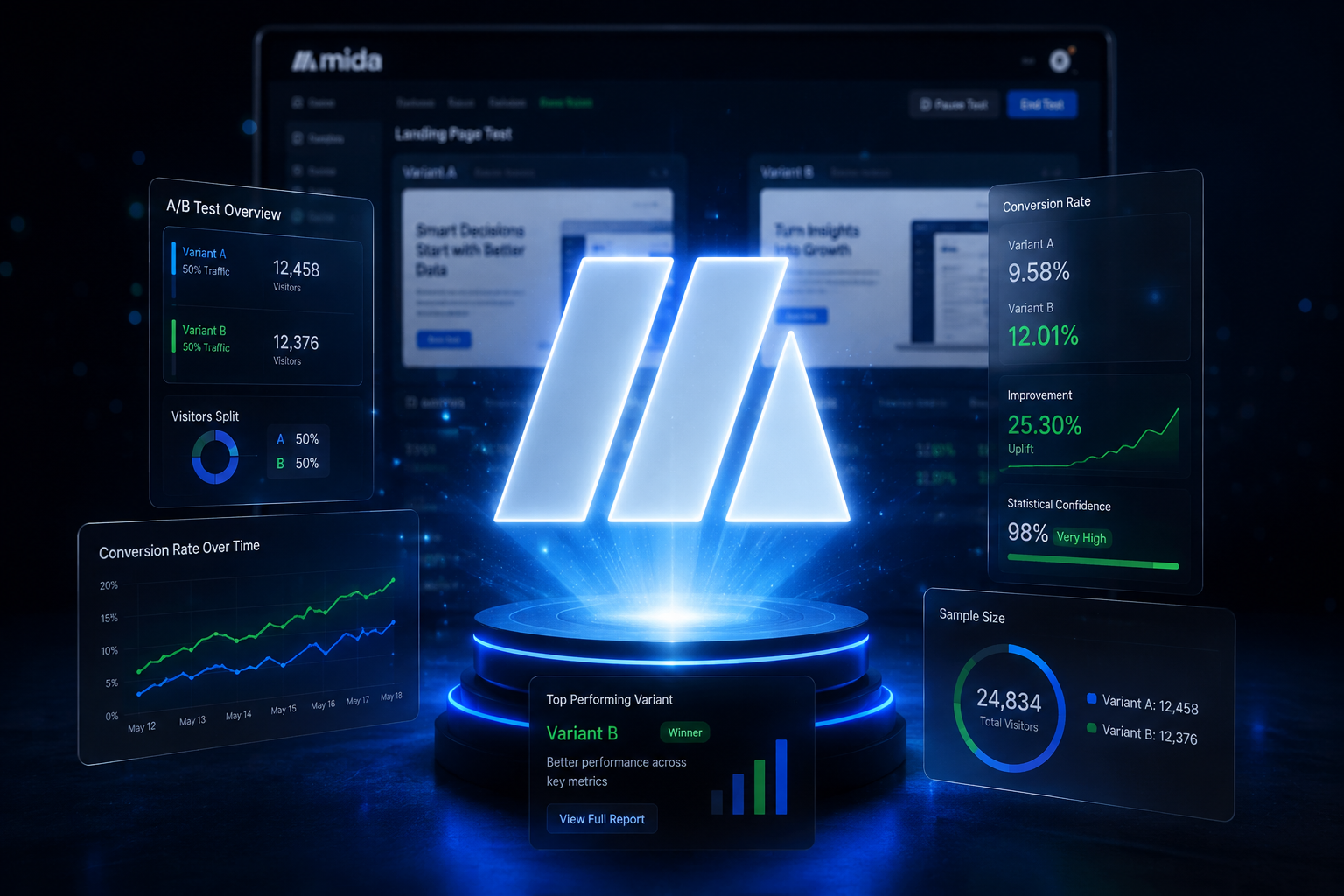
Mida is a lightweight, no-code A/B testing platform built for marketing and CRO teams who don’t want to wait on engineering to ship an experiment. It pairs a fast visual editor with AI features like MidaGX (natural-language test generation) and Sunny AI (test analysis), plus a genuinely generous free tier. It’s not built to replace enterprise suites like Optimizely — it’s built for teams that want speed.
What Is Mida?
Mida is an AI-powered, lightweight A/B testing and experimentation platform aimed at marketing teams, CRO specialists, agencies, ecommerce brands, and SaaS companies. In practice, it lets you launch website experiments, personalize pages, run split URL tests, and measure conversions — without opening a ticket for a developer.
The pitch is straightforward: most A/B testing tools have become bloated. Mida’s script weighs around 20KB, compared to the 200KB+ many competitors load on every page view. That’s not a marketing footnote — page speed affects both user experience and the validity of your test results, since a sluggish script can itself skew behavior.
Mida positions itself explicitly as a Google Optimize alternative, which matters given how many teams were left without a home after Google sunset that product. It also plugs directly into GA4, so experiment data flows into the analytics environment most CRO teams already live in daily — no manual event mapping or extra data-layer work required.
If your team already tracks performance through analytics tooling built for AI-driven online businesses, Mida is the layer that turns those insights into testable hypotheses — it’s not trying to be your analytics platform, it’s what you point at after the data tells you something is worth testing.
The Archetypal Scenario
Picture a small ecommerce brand or an early-stage SaaS company. The growth or marketing lead has a backlog of test ideas — a new headline, a repositioned CTA, a different pricing page layout — but the dev team is buried in feature work, and every test request sits in a queue for two to three weeks. By the time the test ships, the “urgent” insight is old news.
This is the exact gap Mida is built to close. A marketer opens the visual editor, makes the change directly on a live preview, sets a goal, and launches — often the same day. For teams stuck in this dev-bottleneck loop, that alone can be the difference between running four tests a quarter and running four a month.
How It Works
Mida’s core workflow has a few key pieces:
Visual and code editors. Non-technical users can change headlines, images, or button copy through a point-and-click editor. Teams that need more control get a code editor for custom JavaScript and CSS.
MidaGX (Generative Experimentation). This is the AI feature that’s genuinely different from marketing fluff. It’s a Chrome extension where you describe a change in plain language — “make the headline bigger” or “add a countdown timer” — and it generates the JavaScript and CSS to make it happen. According to Mida’s own documentation, it uses your written instruction, a screenshot of the page, and the page’s HTML structure — but explicitly does not use visitor data, analytics, or any customer PII to generate the change.
Sunny AI. An interactive assistant for reading test results. It answers questions about statistical significance and helps decide when to stop or scale a test, using aggregate test statistics rather than raw visitor data.
GA4-native measurement, feature flagging, and personalization. Beyond straight A/B tests, Mida supports split URL testing, SPA experimentation, feature flags, and page personalization, along with Figma design import for turning mockups into live variants.

Who Mida Is For
- Growth and CRO teams without dedicated engineering support, who need to launch and iterate on tests independently.
- CRO agencies managing experiments across multiple client sites, where speed and simplicity across accounts matter more than deep statistical customization.
- Ecommerce brands and early-stage SaaS companies that want to start testing without committing budget upfront — the free plan supports up to 100,000 monthly test users.
- Teams already on GA4 who want experiment data to land directly in the analytics stack they use daily, rather than in a separate reporting silo.
Who Mida Is NOT For
Mida is explicit about this itself, and it’s worth taking seriously: it is not a feature-for-feature replacement for enterprise suites like Optimizely or VWO. If your organization needs advanced multivariate testing, deep statistical modeling options, extensive API-driven server-side experimentation, or enterprise compliance certifications baked into the platform, Mida is likely too lightweight for that scope.
It’s also not the right fit if:
- Your team runs experiments primarily server-side or needs deep backend experimentation infrastructure rather than front-end visual/code editing.
- You need a mature, long-established ecosystem of third-party integrations comparable to what Optimizely has built over a decade.
- Your organization requires enterprise-grade SLAs and dedicated account management as a baseline requirement rather than an add-on.
What We Like
- Genuinely lightweight script — the ~20KB footprint is a real technical advantage, not just a claim, since heavier scripts can introduce flicker and slow page loads that distort test outcomes.
- MidaGX is real AI utility, not a buzzword feature. Generating working JS/CSS from a plain-language description removes a common bottleneck for non-technical marketers who have an idea but no code skills.
- Native GA4 integration removes a step most competing tools still require manual configuration for.
- The free plan is unusually generous for a tool in this category — 100K monthly test users, unlimited tests, and unlimited team members, according to Mida’s own pricing page.
- Privacy-conscious AI design. Mida’s documentation is specific about what data its AI features do and don’t touch, explicitly excluding visitor PII and analytics data from AI processing.
Real Drawbacks
- Not built for enterprise-scale experimentation programs. Teams running dozens of simultaneous tests with complex statistical models will likely outgrow Mida’s scope.
- The free plan’s caps out at 2 active projects and 2 concurrent tests — fine for a single site running one experiment at a time, but a real ceiling the moment a team wants to test in parallel.
- Third-party ecosystem is younger than legacy competitors. Compared to a decade-old platform like Optimizely, Mida’s integration library and community-built resources are still growing.
- MidaGX depends on a Chrome extension, which adds a browser dependency some teams may find limiting if their workflow spans multiple browsers or environments.
Pricing and What’s Included

Mida prices by Monthly Tested Users (MTU) rather than by seats, so the whole team can use the platform without extra per-user cost. The free Sandbox tier is genuinely usable — it covers up to 100,000 tested users a month, includes GDPR and ISO 27001 compliance, and comes with a real (if limited) allotment of MidaGX AI credits. Where it shows its ceiling is scale: only a couple of concurrent tests and active projects, which suits a single site running one experiment at a time but gets tight fast for anything more ambitious.
The Growth plan, at $299/month billed annually (or $399 billed monthly), is where those limits disappear — unlimited tests, unlimited AI credits, and enough active projects for most single-brand teams or small agencies to run a real experimentation program. A 15-day free trial makes it low-risk to validate before committing. Above that, Enterprise moves to custom pricing, trading testing volume for compliance guarantees like SSO and SLAs, plus dedicated support — built for organizations with procurement requirements rather than higher-traffic needs.
One detail worth flagging: even on Growth, active project limits scale with the plan. Agencies running multiple client accounts in parallel should check their real project count against each tier before assuming “unlimited tests” means unlimited scale across the board.
How Mida Compares
Against Google Optimize (now discontinued), Mida picks up the obvious gap left in the market — no-code visual editing, GA4-native measurement, and a similar “marketer-first” philosophy, without Google’s dependency risk of sunsetting a free tool without warning.
Against Optimizely or VWO, Mida trades deep enterprise feature depth for speed and simplicity. If your team’s bottleneck is waiting on engineering, Mida’s lighter footprint wins. If your bottleneck is statistical sophistication at scale, an enterprise suite remains the stronger fit.
Against generic AI website builders with test features bolted on, Mida’s advantage is focus — it was built specifically for experimentation workflows, not as a side feature of a broader product.
For a broader view of how Mida fits alongside other AI-driven optimization and analytics tools, see our full breakdown in Best AI Tools for Online Business 2026.
Final Verdict
Mida earns its “lightweight Google Optimize alternative” positioning. For growth and CRO teams that need to move fast without an engineering queue, the combination of a fast visual editor, native GA4 integration, and a real AI feature in MidaGX makes it a sensible starting point — especially given the free plan’s generous cap. Teams with enterprise-scale experimentation needs, however, should treat Mida as a stepping stone rather than a permanent home.
For more on how a tool like Mida fits into a broader AI-powered online business stack, see our AI Online Business 2026 hub.
Frequently Asked Questions
How is Mida different from Google Optimize?
Mida offers similar no-code visual editing and GA4-friendly measurement but remains an actively maintained, independent platform rather than a discontinued Google product. It also adds AI features like MidaGX that Google Optimize never had.
What exactly does MidaGX do?
MidaGX is a Chrome extension that turns plain-language instructions into working JavaScript and CSS for your test variant. It uses your instruction, a screenshot, and the page’s HTML — not visitor data or analytics.
Is Mida a good fit for enterprise experimentation programs?
Not really — Mida itself positions the platform as lightweight rather than a replacement for enterprise suites like Optimizely or VWO. Teams running large-scale, statistically complex programs will likely need more advanced tooling.
How generous is the free plan really?
It supports up to 100,000 monthly test users with unlimited event tracking on paid tiers, though the free tier caps out at 2 active projects and 2 concurrent tests. That’s enough for a small ecommerce or early-stage SaaS team to run one real experiment at a time, but not for parallel testing.
Does Mida require a developer to set up?
No — that’s the core premise. The visual editor covers most common changes, and the optional code editor is there for teams that want more control, not as a requirement.
Who should skip Mida?
Teams needing deep multivariate statistical modeling, server-side experimentation infrastructure, or an enterprise-grade integration ecosystem are better served by a more mature enterprise platform.
About the Author
Lydia — Salles & Co. Digital
Lydia covers AI-driven tools for online business, growth, and optimization, with a focus on helping marketers and founders separate genuine product value from surface-level AI claims.
Some links may be affiliate links, meaning she may earn a commission at no additional cost to you.