Last Updated on September 17, 2026 by Lydia — Salles & Co. Digital
Disclosure: This post (Kartra Review) contains affiliate links. If you sign up through them, we may earn a commission at no additional cost to you. This review reflects an independent, honest assessment.

TL;DR
Kartra consolidates the entire customer journey — funnels, email, checkout, CRM, membership — into one controlled system. It creates real leverage once a business already has a validated offer and defined structure, but it slows down execution for anyone still testing.
What You’re Actually Evaluating
Most reviews treat Kartra as another marketing tool with a page builder, email automation, and a checkout page attached. That framing produces shallow conclusions, because it misses the platform’s actual premise: Kartra is built to replace a stack of disconnected tools with one controlled environment for the entire customer journey — not to compete feature-by-feature with a single-purpose tool.
If you’re exploring how AI-driven platforms fit into a broader online business strategy in 2026, this fits into a larger conversation about building an AI-powered online business — Kartra is one infrastructure choice inside that bigger picture, not the whole answer.
What Changes When Everything Lives Inside One System
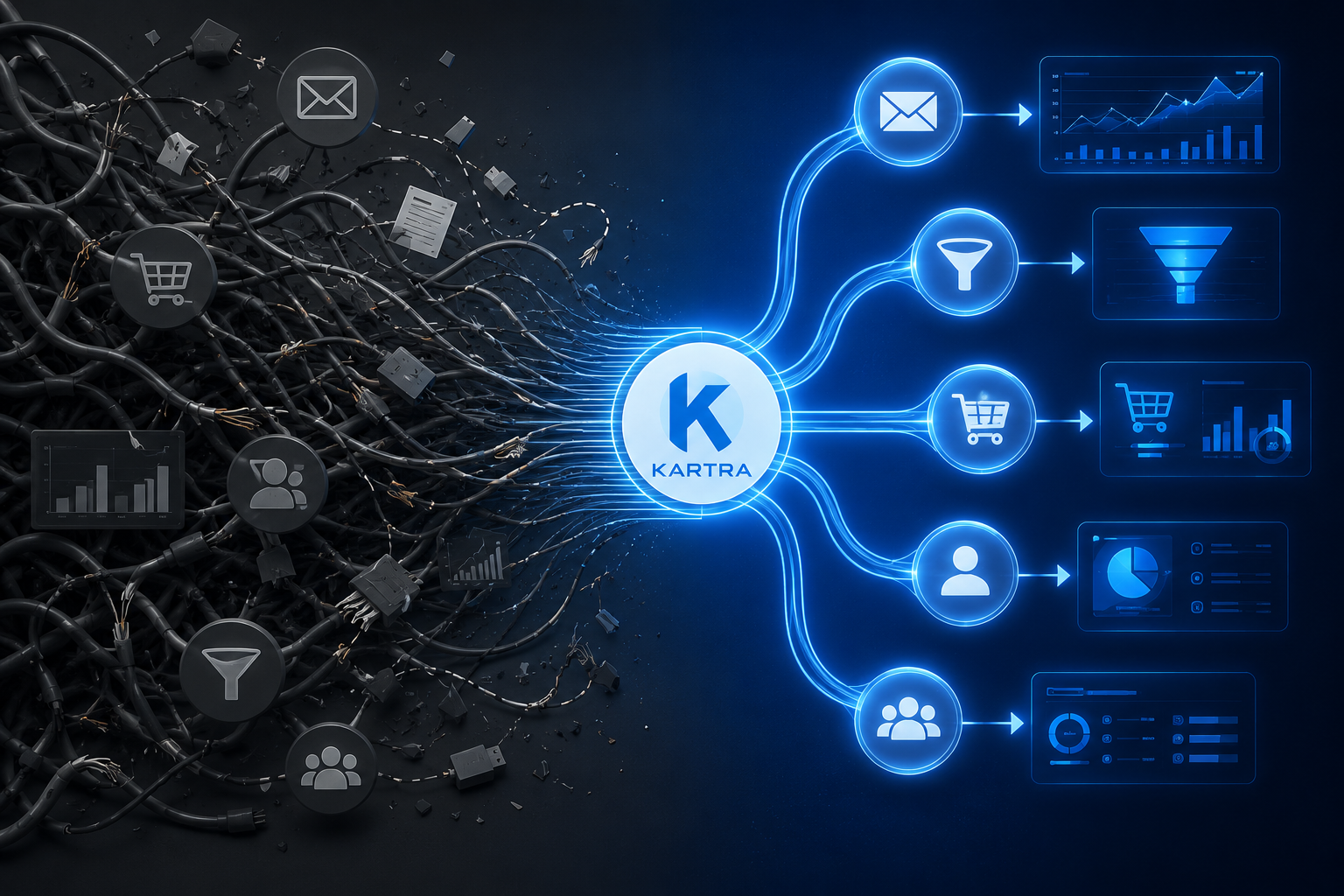
A typical stack connects a landing page builder, an email platform, a payment processor, and a content delivery system through integrations. It works, but friction accumulates: data fragments across tools, automations depend on third-party connections that can break, and diagnosing a broken flow means checking multiple dashboards.
Inside Kartra, that fragmentation disappears structurally. Every touchpoint — opt-in, segmentation, follow-up, purchase, content access — happens inside the same system, tracked against the same customer record. The practical shift is that you stop managing tools and start managing flows.
Where Kartra Creates Real Leverage
The platform performs best when the business already has a validated offer and a defined path from acquisition to monetization. A creator running a webinar, course, membership sequence can manage the entire lifecycle — acquisition, conversion, delivery, retention — from a single dashboard, with unified data behind every decision.
That’s not incremental convenience. Removing integration dependencies at this stage changes how fast you can iterate on the actual business, because you’re no longer debugging broken connections between four tools.
Where the Same Design Becomes a Constraint
The same depth that creates leverage in a structured business becomes resistance in an unstructured one. Kartra assumes a level of clarity — defined funnel, defined offer, defined audience — that early-stage testing hasn’t produced yet.
A founder still validating demand benefits more from speed and low commitment than from a system that rewards upfront structure. Setting up automations and lifecycle flows before confirming the offer converts is a common trap: time gets spent building infrastructure for a business model that hasn’t been proven yet.
This is a contra, not a caveat: if you’re pre-validation, Kartra’s depth works against you.
For a closer look at how AI-driven sales funnels are structured for already-validated offers, see this breakdown.
The Trade-Off That Actually Defines the Decision
Choosing Kartra means choosing integration over flexibility. Specialized tools let you experiment faster and swap pieces independently; Kartra centralizes everything, which reduces long-term friction but raises the cost of early exploration.
Kartra vs. ClickFunnels vs. Kajabi
- ClickFunnels — optimized for rapid funnel deployment with minimal structure. Best when speed to launch matters more than lifecycle depth.
- Kajabi — built around content delivery and community, weaker on CRM-level automation and multi-stage lifecycle logic.
- Kartra — attempts to unify both, adding deeper CRM and automation on top. This breadth is the advantage for complex ecosystems and the disadvantage for simple ones.
If you want a side-by-side of where Kartra ranks among other AI-enabled tools for online business in 2026, this comparison of the best AI tools for online business puts it in context against alternatives.
Pricing: What You Actually Pay, Tier by Tier
Kartra runs four core plans, each scaling by contact limit rather than by feature access — every tier includes the full funnel, email, checkout, and membership toolkit.
| Plan | Monthly | Annual (per mo) | Contacts | Best For |
|---|---|---|---|---|
| Essentials | $59 | $52 | 500 | Testing the platform, 5% transaction fee applies |
| Starter | $119 | $99 | 2,500 | Solo creators, 0% transaction fee |
| Growth | $229 | $189 | 12,500 | Small teams, higher-volume webinars |
| Professional | $549 | $429 | 25,000 | Agencies, established businesses |
Annual billing saves 12–22% depending on tier. All plans include a 14-day free trial, and paid plans carry a 30-day money-back guarantee.
Judged against a single tool — an email platform or a page builder alone — this looks expensive. Judged against what it replaces (funnel builder + email automation + checkout + CRM + course hosting + affiliate management), the combined cost of separate tools frequently exceeds Kartra’s plan cost once a business is past the testing phase.
Pre-validation stage: even the Essentials tier is commitment without certainty — that 5% transaction fee also erodes margin exactly when margin is thinnest.
Post-validation stage: the Starter or Growth tier typically pays for itself in reduced tool-switching friction alone.
Kartra also runs limited-time promotional offers on top of the standard trial. There’s currently an offer for 3 months of the Starter plan for $99 total — equivalent to 2 months free compared to the standard $119/mo rate. Check if this offer is still active before signing up at standard pricing.
Pros
- Centralizes funnels, email, checkout, CRM, and membership in one data environment
- Eliminates integration dependencies and their failure points
- Enables sophisticated lifecycle management without external tools
- Segmentation and automation are more precise because they run on unified customer data
- 14-day free trial removes the need to commit before testing
Cons
- Assumes structural clarity (defined offer, funnel, audience) that early-stage businesses often don’t have yet
- Steeper learning curve than single-purpose tools like ClickFunnels
- Higher cost than any individual tool if you’re not yet using the breadth of features
- Less specialized than Kajabi for pure content/community models, and slower to launch a single funnel than ClickFunnels
What Actually Drives Results Inside Kartra
Kartra doesn’t generate results by itself — it amplifies an existing structure. With a clear funnel and monetization strategy, it reduces friction between stages. Without that structure, the platform underperforms — not because it lacks capability, but because execution stays fragmented at the strategy layer, which no platform can fix.
Common Mistakes That Lead to Poor Results
- Expecting the platform to simplify everything automatically, rather than requiring a defined strategy first
- Building complex automations before validating that the offer converts
- Using Kartra as just a page builder, ignoring the CRM and lifecycle tools that justify its cost
- Underestimating that funnel design is the user’s job — Kartra executes the strategy, it doesn’t create one

Final Verdict
Kartra is a genuinely comprehensive platform, but calling it “good” or “bad” misses the real variable at play: fit for stage. For a business that already has a validated offer, a defined funnel, and a need to manage acquisition, conversion, delivery, and retention without stitching together four separate tools, Kartra removes real operational friction. The consolidation isn’t cosmetic — it changes how fast you can iterate once the fundamentals are already proven.
For anyone still testing whether an offer converts, that same depth works against you. You end up building automations and lifecycle flows for a business model that hasn’t been validated yet — time spent on infrastructure instead of on the one thing that actually matters at that stage: confirming demand.
So the practical filter is simple. If your bottleneck is tool fragmentation — juggling a page builder, an email platform, a checkout system, and a CRM that don’t talk to each other — Kartra is built exactly for that problem. If your bottleneck is still “does anyone want this,” a lighter tool will serve you better until the offer is proven.
No commitment beyond the trial window, and full access to the automation, funnel, and CRM tools discussed in this review.
Frequently Asked Questions
Is Kartra worth it if I’m still testing a new offer?
Generally not yet. Kartra rewards businesses with a defined funnel and validated demand; testing an unproven offer benefits more from faster, lower-commitment tools.
What’s the biggest limitation of Kartra compared to ClickFunnels?
ClickFunnels launches a single funnel faster with less setup. Kartra’s depth adds a learning curve that slows initial deployment, even if it pays off at scale.
How does Kartra’s pricing compare to using separate tools?
A typical separate stack (funnel builder, email platform, checkout, CRM, course host) often costs more combined than Kartra’s plans, but only once you’re using most of those functions.
Who should avoid Kartra?
Businesses still validating their offer, or those needing only one function (like a page builder or email tool) without the rest of the lifecycle stack.
Can I test Kartra before committing to a paid plan?
Yes, Kartra offers a 14-day free trial specifically to evaluate the system inside a real workflow before paying.
Does Kartra work well for content creators focused on community?
It can, but Kajabi is more specialized for content and community-first models; Kartra’s advantage shows more in CRM-heavy, multi-stage funnels.
About the Author
Lydia — Salles & Co. Digital
Lydia is a strategic affiliate focused on international digital products, AI tools, and premium online business platforms. She evaluates infrastructure-level tools like Kartra through an operational lens — fit for stage, not just feature count.
Some links may be affiliate links, meaning she may earn a commission at no additional cost to you.