Last Updated on September 17, 2026 by Lydia — Salles & Co. Digital

Quick Answer
An AI sales funnel uses AI to accelerate four stages — capture, nurture, offer, and close — inside a funnel you design first. AI speeds up each step; it doesn’t replace the structure. Build the path, then automate it. Skip the structure and automation just fails faster.
Who this is for
If you’ve got traffic and content but the sales aren’t following, this is for you. You don’t have a traffic problem — you have a conversion path problem. By the end, you’ll know how an AI sales funnel is actually structured, where to plug AI into each stage, and which moves quietly break it.
This page is about converting. Creating the content that feeds the funnel lives in a different part of the cluster — see AI Content Workflow — and so does the day-to-day AI automation that keeps it running.
How an AI sales funnel actually works (the 4 stages)
An AI sales funnel isn’t a tool. It’s a path a stranger walks from “who are you” to “take my money,” with AI shortening the time between each step.

The four stages, in order:
- Capture — a visitor becomes a known lead (email, opt-in, quiz answer).
- Nurture — that lead builds enough trust to consider buying.
- Offer — you present something specific to buy, framed for a specific problem.
- Close — you remove the last friction (objections, payment, timing).
In practice, this means the funnel exists whether or not you use AI. What AI does is compress the work: drafting nurture sequences, scoring leads, personalizing offers, and surfacing who’s ready to close. The trade-off here is that AI amplifies whatever you built — a clear path or a leaky one.
If you’re starting from scratch, design the four stages on paper before you touch a single automation. The step most people skip is mapping what the lead needs to believe before each stage moves forward.
Where to plug AI into each funnel stage
AI earns its place at specific points, not everywhere at once.
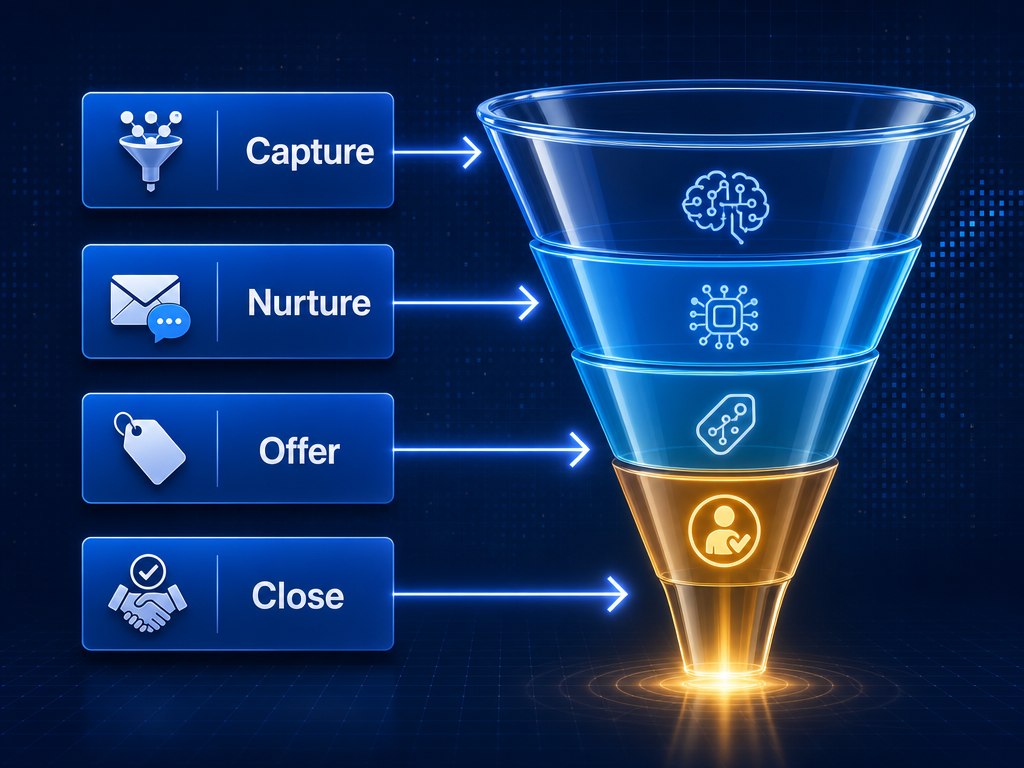
- Capture: AI-assisted quizzes and dynamic opt-ins that route leads by intent. A quiz tool that segments on the way in saves you from a flat, one-size list.
- Nurture: AI drafts and personalizes email sequences based on behavior — opened, clicked, ignored. You still approve the logic; AI fills the volume.
- Offer: AI helps match the right offer to the right segment, and rewrites offer copy per audience. It does not decide what to sell.
- Close: AI scores leads by readiness so your follow-up (or your sales call) targets the warm ones first.
For an all-in-one platform that handles capture, nurture, and checkout in one place, teams often reach for a tool like Kartra. Whether you need all-in-one or a stack of specialists depends on volume — and that comparison belongs on its own page.
When to automate vs. when to keep it manual
Not every stage should be automated on day one.
Automate when: the step is repetitive, the message is stable, and you already know it converts manually. Capture and early nurture automate well.
Keep it manual when: the conversation is high-stakes, the offer is expensive, or you haven’t validated the message yet. Closing a high-ticket offer by pure automation usually leaves money on the table.
This works when you’ve manually closed a few sales and know the objections. This breaks when you automate a script you’ve never tested on a real human. Automate the proven, not the hopeful.
How to set up nurturing before you sell
This is the stage the persona skips most — and it’s why traffic doesn’t convert.
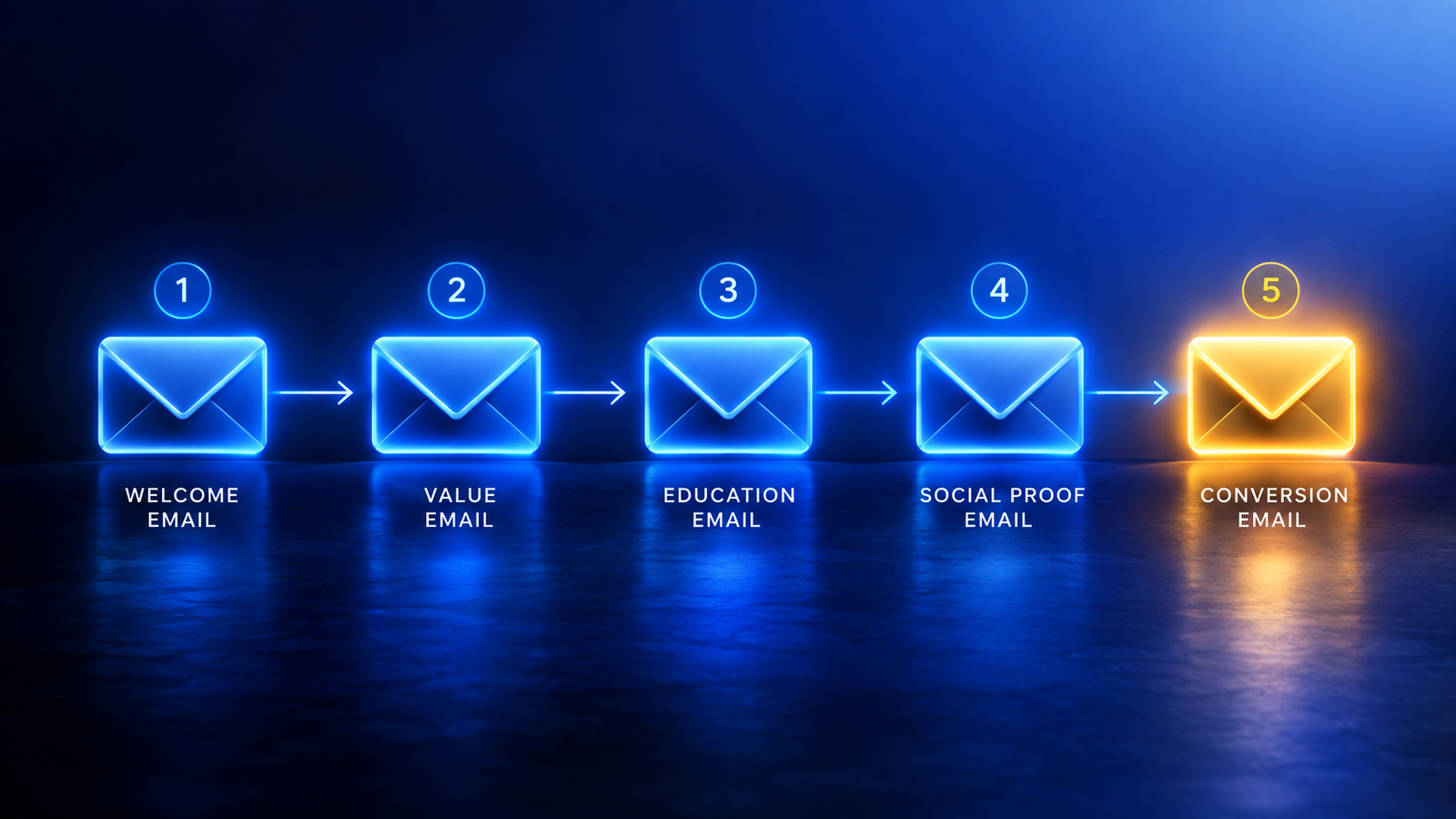
A workable sequence, before any hard offer:
- Email 1–2: deliver on the opt-in promise; establish the problem clearly.
- Email 3–4: show how the problem gets solved (your angle, not your product yet).
- Email 5: introduce the offer as the obvious next step, not a cold pitch.
AI accelerates this by drafting variants and adapting tone per segment. But the sequence logic is yours. A common mistake is letting AI generate a 7-email sequence with no clear belief-shift between emails — volume without movement.
Mini-scenario: A creator with 8k email subscribers had a 0.3% sales rate. The funnel jumped straight from opt-in to “buy now.” Adding a 4-email nurture that addressed one objection per email — drafted with AI, sequenced by hand — was the change that moved the needle.
Common Pitfalls
1. Automating the sale before any nurture exists.
Sending an offer to a cold opt-in treats a stranger like a buyer. Leads who get a value-first nurture sequence consistently convert better than those pitched immediately — the trust gap is real, and automation doesn’t close it for you. Nurture first, then offer.
2. Running a webinar with no clear offer.
A webinar that “educates” but never asks for the sale produces applause, not revenue. If there’s no single, specific offer with a deadline at the end, the close stage doesn’t exist. Decide the offer before you script the webinar.
3. Building a CRM with no segmentation.
Dumping every lead into one list means everyone gets the same message — and AI personalization has nothing to work with. Without segments (by source, behavior, or intent), your “AI funnel” is just a faster way to send generic email. Segment at capture, not later.
4. Trusting AI lead scores you never validated.
AI scoring is only as good as the signals you feed it. Acting on scores before checking them against real closed deals means chasing the wrong leads with confidence. Validate the score against outcomes before you route follow-up by it.
Summary — Key Takeaways
- An AI sales funnel is a 4-stage path (capture → nurture → offer → close); AI accelerates it, it doesn’t replace it.
- Design the funnel on paper before automating any stage.
- Plug AI in stage by stage: routing at capture, drafting at nurture, matching at offer, scoring at close.
- Automate the proven; keep high-stakes closes manual until validated.
- Nurture before you sell — the missing sequence is why traffic doesn’t convert.
- Segmentation at capture is what makes every later AI step work.
FAQ
How long should an AI sales funnel nurture sequence be?
Long enough to shift belief, usually 4–6 emails before a hard offer. Length matters less than whether each email moves the lead forward.
Should I automate my whole sales funnel with AI from the start?
No. Automate proven, repetitive stages (capture, early nurture) first. Validate high-stakes closes manually before automating them.
When does AI lead scoring actually help?
Once you have enough closed deals to validate the signals. Before that, the score is a guess wearing a number.
Do I need an all-in-one platform to run an AI sales funnel?
Not necessarily. All-in-one simplifies the stack; a specialist stack gives more control. It depends on volume and how many tools you want to manage.
What’s the single most common reason an AI sales funnel fails to convert?
Selling before nurturing. The structure jumps from opt-in to offer with no trust built in between.
Keep going
- Start here: AI Online Business 2026 — the full system
- Feed the funnel: AI Content Workflow
- Automate operations: AI Automation for Online Business
- Measure it: AI Analytics for Online Business
- Compare funnel platforms: Best AI Tools for Online Business
About the author
Lydia — Salles & Co. Digital
Lydia writes about building AI-driven online businesses that actually sell. This guide focuses on the conversion engine — turning traffic into revenue with funnels that are designed first and accelerated by AI second.
More about Lydia