Last Updated on October 26, 2026 by Lydia — Salles & Co. Digital
This FunnelFlux Pro review contains affiliate links. If you purchase through them, we may earn a commission at no additional cost to you. This does not influence our editorial assessment.
TL;DR
FunnelFlux Pro is a visual, node-based tracking platform built for affiliates and media buyers running paid traffic at scale. It handles conversion tracking, funnel mapping, and postback/CAPI integrations with more flexibility than most entry-level trackers, but it comes with a learning curve that isn’t ideal for beginners.Z
What Is FunnelFlux Pro?
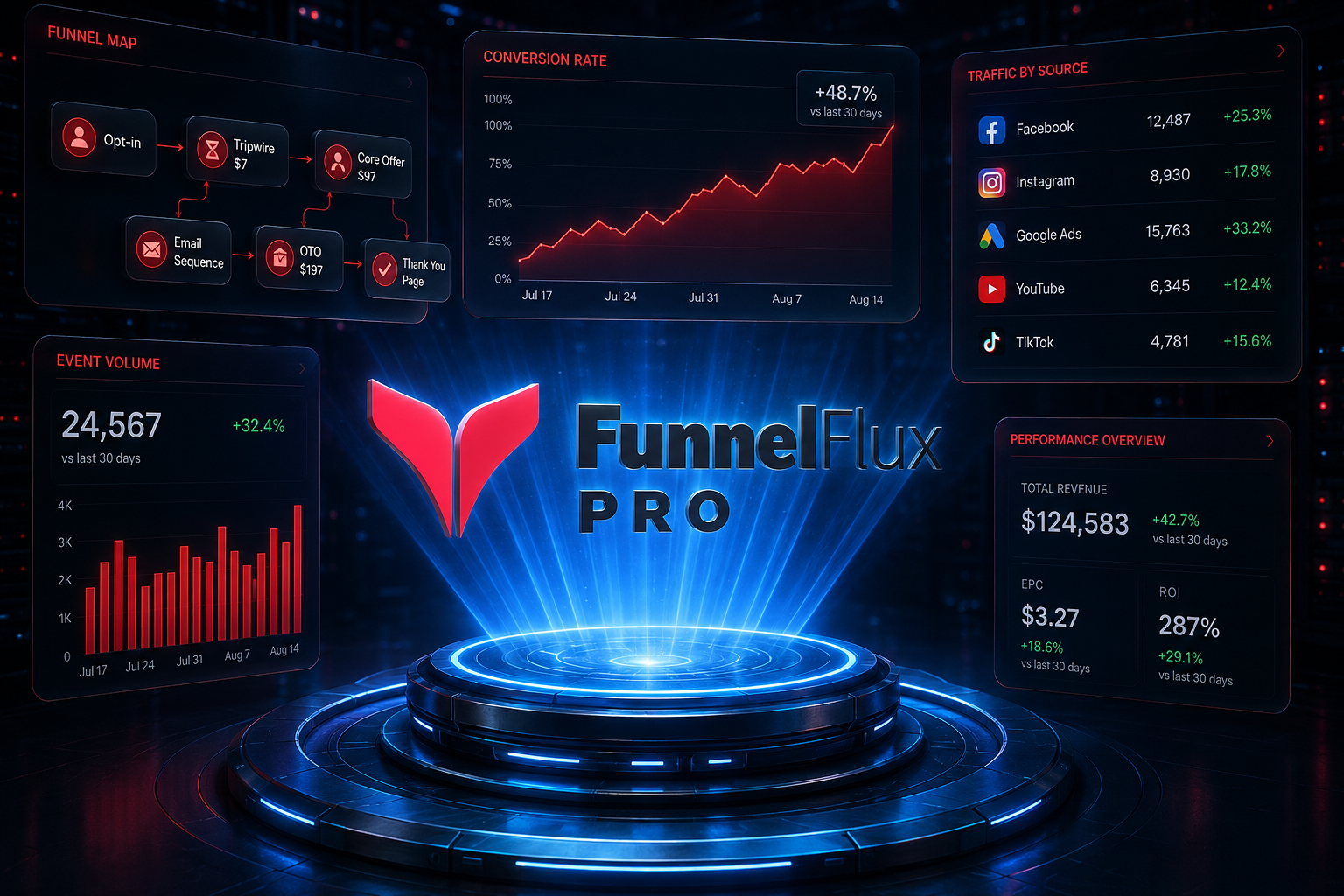
FunnelFlux Pro is a cloud-based tracking and funnel-mapping tool. Instead of managing tracking through spreadsheets or basic link redirects, users build funnels visually — as connected nodes representing traffic sources, landing pages, offers, and conversion events. Each node carries its own tracking logic, letting you see exactly where traffic drops, converts, or leaks along the path.
The platform positions itself for performance marketers who already run traffic on multiple networks (Facebook, native ad platforms, affiliate networks) and need a centralized system to attribute conversions accurately across all of them.
The Scenario This Solves
Picture someone running paid traffic across three or four ad networks, promoting affiliate offers with multiple landing page variants. Without a proper tracker, they’re stitching together data from ad platform dashboards, network reporting, and guesswork. Attribution breaks down fast — especially with iOS 14.5+ restrictions and third-party cookie deprecation making browser-side tracking increasingly unreliable.
This is the exact gap FunnelFlux Pro targets: server-side tracking with conversion API (CAPI) integrations that don’t depend on client-side cookies to report accurately back to ad platforms. If you’re still mapping out how conversion tracking fits into your broader sales funnel, this is the layer that sits underneath all of it.
How It Works
Setup happens on FunnelFlux’s own dashboard. You create “nodes” for each element of your funnel — traffic source, lander, offer — and connect them visually. The platform then generates tracking links and pixels you deploy across your campaigns. Data flows back in near real time, with reporting broken down by traffic source, campaign, and even individual creative.
Integrations include major ad platforms’ server-side APIs, several affiliate networks, and popular landing page builders. Setup for a single funnel takes anywhere from 20 minutes to a few hours depending on complexity and how many integrations you’re connecting simultaneously.

Who FunnelFlux Pro Is For
- Affiliates and media buyers running paid traffic across 2+ networks who need centralized attribution
- Performance marketers already burned by inaccurate pixel-based tracking post-iOS 14.5
- Agencies managing tracking infrastructure for multiple client accounts
- Users comfortable with a technical setup process in exchange for long-term flexibility
Who FunnelFlux Pro Is NOT For
- Complete beginners running their first one or two campaigns — the node-based interface has a real learning curve, and simpler tools like ClickMagick or a native platform’s built-in pixel will suffice at that stage.
- Low-volume advertisers spending under a few hundred dollars a month — the platform’s pricing structure (tied to click volume) makes it inefficient at very low scale.
- Organic-only marketers with no paid traffic — FunnelFlux Pro’s core value is attribution across paid channels; it adds little for someone relying purely on organic or content-driven funnels.
Pros
- Server-side CAPI integrations that hold up against iOS/browser tracking restrictions
- Visual funnel builder makes complex multi-path campaigns easier to audit
- Granular reporting down to individual creative and landing page variant
- Works across multiple ad networks and affiliate platforms simultaneously
Cons (Real Limitations)
- Steep learning curve. The node-based system is powerful but not intuitive for first-time users — expect several hours before you’re comfortable building funnels independently.
- Pricing scales with volume, which means costs can climb quickly for high-traffic accounts, and the exact tier you’ll land on isn’t obvious until you run the numbers.
- No native email marketing or CRM features — this is strictly a tracking and attribution tool, not an all-in-one funnel builder like ClickFunnels or Systeme.io.
Pricing and What’s Included
FunnelFlux Pro uses a click-volume-based pricing model rather than a flat monthly fee. The base plan starts at $99/month, which includes up to 2 million tracked events per month. If your traffic volume exceeds that cap, additional events are billed at $10 per million events beyond the included allowance — so the exact cost you’ll pay depends on your actual traffic volume and which tier you fall into.
Billing Notes
- Base Plan: $99/month includes 2 million events per month
- Event Overages: Additional events beyond 2 million are charged at $10 per million events
- Trial Period: All subscriptions include a 14-day free trial with full access to all features
- Billing Cycle: Monthly subscription with no annual contracts required — cancel anytime
Because pricing scales with real usage, the official calculator on FunnelFlux’s pricing page is the most reliable source for estimating your specific tier and monthly cost based on projected traffic.
All tiers include the core funnel-building interface, CAPI integrations, and reporting dashboard. Higher tiers unlock higher click volume caps and, in some cases, additional integrations.
FunnelFlux Pro vs. Alternatives
Compared to entry-level trackers like ClickMagick, FunnelFlux Pro offers a materially more flexible funnel structure and stronger server-side attribution, at the cost of a steeper setup process. Compared to Voluum, FunnelFlux Pro’s visual node system tends to make multi-path funnel logic easier to audit at a glance, though Voluum has broader native integrations out of the box in some categories.
If your operation depends on tracking conversion accuracy across a complex, multi-network paid traffic stack, compare FunnelFlux Pro with other funnel optimization tools in the stack before deciding which piece of infrastructure fits your specific setup.
Final Verdict
FunnelFlux Pro isn’t built for casual use — it’s built for marketers already running real paid traffic volume who’ve felt the pain of unreliable attribution. For that specific profile, the visual funnel builder and CAPI integrations solve a genuine, recurring problem. For anyone earlier in their journey, the learning curve and volume-based pricing make it overkill.
If tracking accuracy across paid channels is a bottleneck in how you scale, see how this fits into the overall AI Online Business strategy before adding it to your stack.
Frequently Asked Questions
Does FunnelFlux Pro work if I only run organic traffic?
Not really — its core value is attribution across paid traffic sources and ad network integrations. Organic-only marketers won’t see meaningful benefit from the CAPI features.
How steep is the learning curve compared to simpler trackers?
Noticeably steeper. The node-based visual builder takes longer to master than link-redirect tools like ClickMagick, though it offers more flexibility once learned.
Is the pricing fixed, or does it change based on usage?
Pricing is based on click volume, not a flat fee, so the exact cost depends on your traffic. The official pricing calculator on FunnelFlux’s site is the only accurate source for your specific tier.
Who should avoid FunnelFlux Pro?
Complete beginners running their first campaigns and very low-volume advertisers are better served by simpler, cheaper tracking tools until they scale.
Does it replace an email marketing or CRM platform?
No — it’s strictly a tracking and attribution tool. You’ll still need separate software for email marketing, CRM, or full funnel building.
About the Author
Lydia — Salles & Co. Digital
Lydia covers digital tools, AI-driven platforms, and premium online business programs, with a focus on helping readers separate genuinely useful infrastructure from overhyped software.
Some links may be affiliate links, meaning she may earn a commission at no additional cost to you.