
AI content repurposing in 2026 allows businesses to turn one strong content asset into multiple platform-ready outputs without creating from scratch every day. Instead of relying on constant manual posting, scalable brands use AI to expand, adapt, and distribute ideas across channels more efficiently.
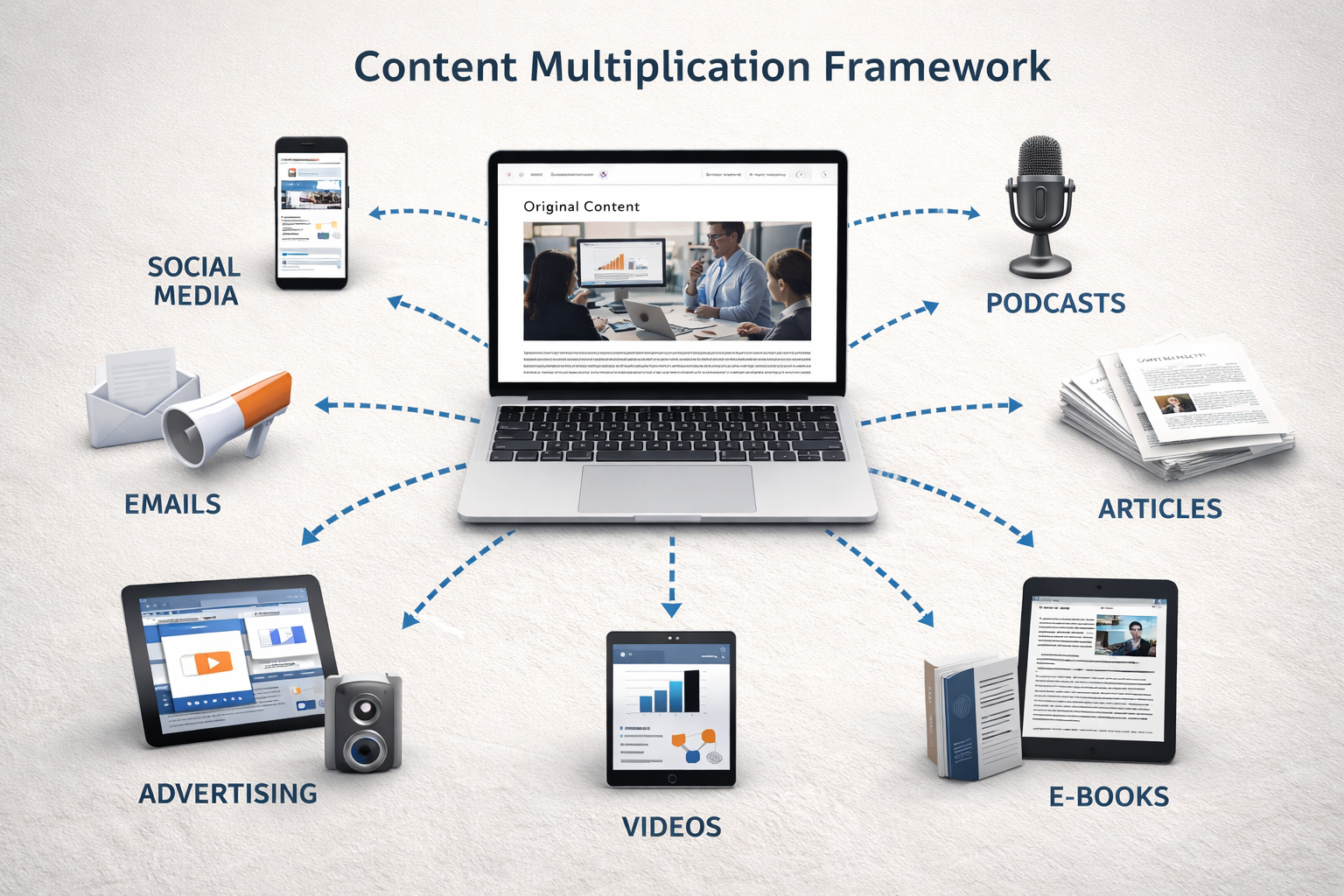
If you want to understand how this fits into a larger AI business system, start with the full framework here:
AI for Online Business in 2026
Why Daily Posting Is a Weak Growth Model
“Post every day” became one of the most repeated pieces of online business advice.
And for a while, it sounded productive.
But in practice, it created a model built on:
- Constant manual output
- No leverage
- No asset reuse
- No compounding structure
The result was not sustainable growth.
It was content exhaustion.
Because when every post starts from zero:
Nothing scales.
The Real Shift: From Content Creation to Content Expansion
The businesses growing with content in 2026 are not creating more.
They are extracting more value from what they already create.
That means shifting from this:
Create → Publish → Repeat
to this:
Create once → Expand → Adapt → Distribute
This is where AI becomes strategically useful.
Not because it creates “more posts.”
But because it makes one strong idea travel further.
The AI Repurposing System That Actually Works
A real repurposing system is not random reposting.
It is structured content multiplication.
That system usually works through three layers:
Layer 1 — Core Asset Creation

Everything starts with one strong primary asset.
That can be:
- A long-form article
- A video
- A podcast
- A live session
- A strategic breakdown
This is the “source idea” that feeds the system.
If the core asset is weak, everything downstream becomes weak too.
Layer 2 — Content Multiplication
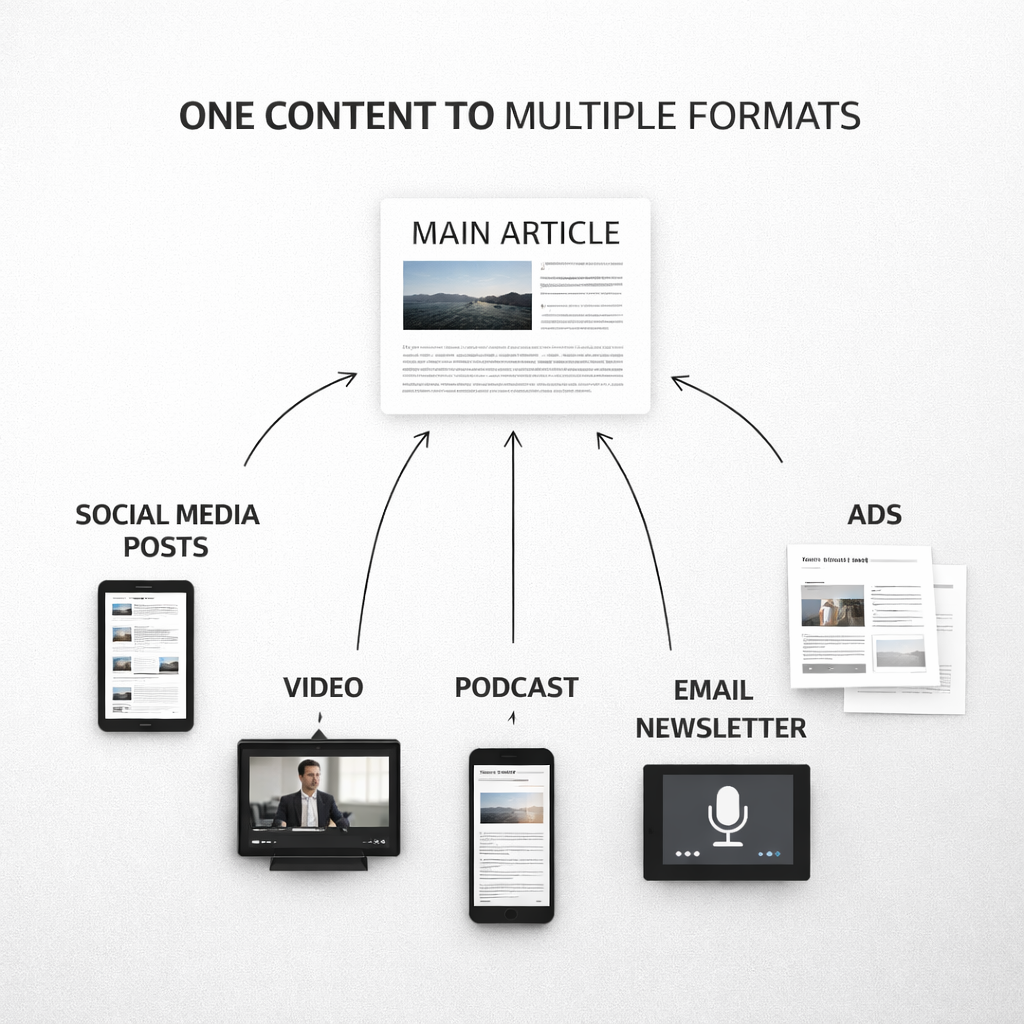
This is where AI creates leverage.
Instead of publishing one piece once, you break it into multiple usable outputs.
One core asset can become:
- Short-form posts
- Threads
- Email content
- Script ideas
- Platform-specific snippets
- Quote graphics
- Content angles for future posts
Same idea
More surface area
More reach potential
Layer 3 — Channel Adaptation
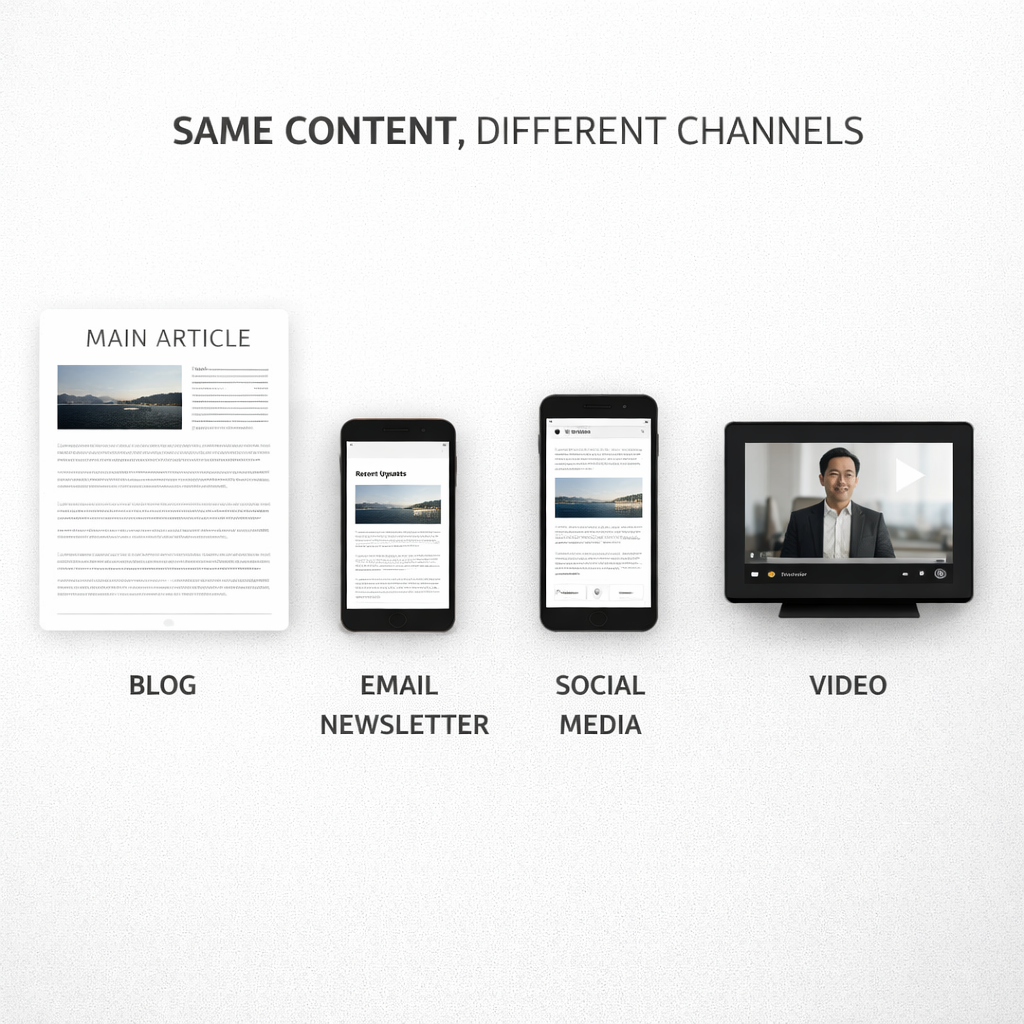
Repurposing is not copying and pasting.
It only works when content is adapted to context.
Because what performs on:
- Search
- Social
- Video
is not always the same.
AI helps here by restructuring the same idea into:
- Different lengths
- Different tones
- Different entry hooks
- Different delivery formats
The message stays aligned
The format becomes native
That is what makes distribution stronger.
Why Most Content Repurposing Still Fails
Most people are not repurposing.
They are just reposting.
And that is why the output feels repetitive, weak, or disconnected.
Common problems:
- Trying to repurpose weak content
- Copying the same format everywhere
- No system for asset extraction
- No connection between platforms
Repurposing only works when the system is built around transformation, not duplication.
What Actually Scales (And Why It Feels Easier)
When repurposing is done correctly:
- One idea produces more reach
- Content becomes reusable
- Output becomes more consistent
- Time pressure decreases
- Growth starts compounding
You are not doing less because you care less.
You are doing less manually because the system is stronger.
The Right Sequence Most People Miss
Many creators and businesses try to do this in the wrong order.
They try to:
- Post daily
- Add repurposing
- Add automation
- Keep everything manual
And the result is usually more complexity.
The better sequence is:
1. Create one strong primary asset
2. Extract multiple usable outputs
3. Adapt for each platform
4. Distribute systematically
Sequence matters more than volume.
What AI Is Actually Good For Here
AI is most useful in repurposing when it helps you:
- Break long-form into short-form
- Reframe one idea for different channels
- Generate alternative hooks and angles
- Turn one message into multiple usable assets
- Reduce repetitive content formatting work
What AI should NOT do here:
- Replace original thinking
- Replace strategic message control
- Publish low-quality output at scale
AI should increase leverage.
Not multiply noise.
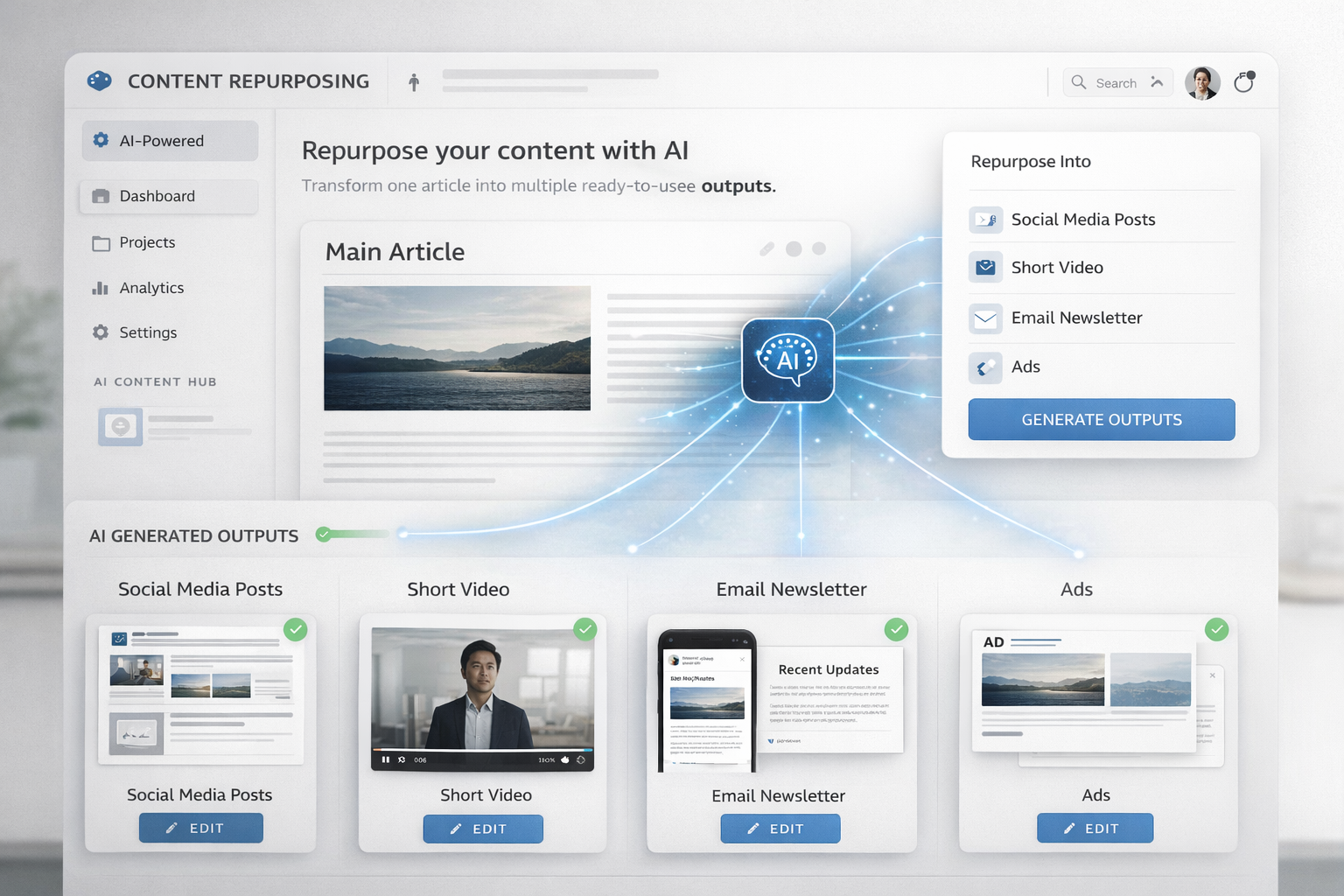
What Actually Works vs What Doesn’t
✅ What Works
- Strong primary assets
- Structured content extraction
- Platform adaptation
- Systematic distribution
❌ What Doesn’t
- Daily posting dependency
- Reposting without adaptation
- Weak source content
- Output without system logic
Before vs After (Real Content Behavior)
Before
Create → post → disappear
High effort
Low compounding
No system
After
Create once → multiply → distribute → compound
Lower manual effort
Higher content leverage
Scalable output
Same idea
Completely different growth potential
The Strategic Value of Repurposing
This is not just a content tactic.
It is an operational advantage.
Because once repurposing is working:
- content becomes more sustainable
- publishing becomes less dependent on energy
- consistency becomes easier to maintain
- growth stops depending on constant reinvention
That is why repurposing is not optional anymore.
It is part of the infrastructure.
Systems that reduce the pressure of constant manual posting can make consistency much easier to sustain over time. Someli is one example of a tool built around that kind of workflow.
If you want to see how content repurposing connects with traffic, automation, and revenue:
This is where content stops being output—and starts becoming a system.
Summary
- AI content repurposing turns one strong asset into multiple outputs
- The goal is not more content, but more leverage
- Repurposing works through multiplication and adaptation
- Reposting is not the same as repurposing
- Scalable growth comes from content systems, not daily posting
Conclusion
The problem was never a lack of discipline.
It was a weak content model.
Creating from scratch every day feels productive.
But it traps your business in a cycle that never compounds.
The real shift is simple:
Stop trying to create more
Start building systems that make each idea go further
About the Author
Lydia (Salles & Co. Digital) is a Strategic Affiliate focused on international digital products, AI tools, premium programs, and high-level business opportunities. She analyzes platforms, launches, and ecosystems from a practical, results-driven perspective before recommending them.